

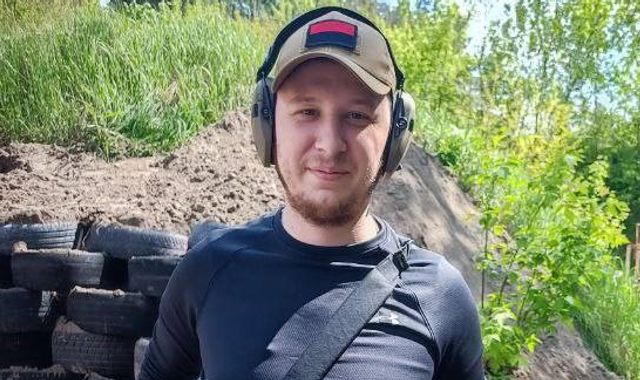
"Everyone in Ukraine should know how to apply a tourniquet and how to stop someone's bleeding," Anatolii says.
And he would know. In 2022, he was part of a small garrison of fighters who held out against appalling odds as the city of Mariupol fell around them.
The siege of the Azovstal steelworks in the opening weeks of the war had far-reaching effects on the battlefield.
Follow live updates: Melania Trump credited with Oleshky ceasefire
The defenders are credited with holding up Russian troops and buying time for Ukrainian forces elsewhere to regroup and rearm.
Four years later, it continues to resonate in both Ukraine and Russia.
Anatolii first signed up for Ukraine's military in 2014 - the year Russia seized Crimea and parts of the Donbas - and served until 2021, when he moved to Poland.
"When the full-scale war began, I simply returned to Kyiv, to Ukraine, that same day," he told Sky News.
"I thought we would have to defend the capital and fight for it."
He joined what became the Third Assault Brigade, one of Ukraine's most elite units whose members included Azov Battalion veterans.
The fight to secure the capital in the early weeks of the war was fierce. But defenders in Kyiv knew that bitter conflicts raged across their country, too.
"During periods of rotation, we were also watching the news and saw that Mariupol was surrounded.
"We also talked about how the guys needed help and that somehow we needed to break through to Mariupol."
Located on Ukraine's south coast, Mariupol was one of the first targets for Russian forces, who sought to establish a land bridge to occupied Crimea.
"Then, towards the end of March, they started gathering people for Mariupol," Anatolii says.
The volunteers weren't initially told what kind of mission it would be.
"They simply said there was an opportunity to help the guys."
But Mariupol at this point was under siege. Any operation would have to break Russian lines or cross them somehow.
The classified mission to reinforce the defenders of Mariupol was to be by helicopter.
Anatolii and others landed at the city's port and engaged Russian forces. They fought their way to the Azovstal steelworks, where many of the city's defenders were holed up against horrific odds.
"I was wounded in the leg during that fighting. I was evacuated to a bunker at Azovstal where there were medics, and they amputated my leg there."
Living at the Azovstal steelworks, a network of underground tunnels, Anatolii encountered surgeon Yevhen Gerasimenko, who previously told his story to Sky News.
More from Sky News:
The Ukrainian surgeon smuggled into Mariupol
Inside Ukraine's wartime postal service
The psychologist helping Ukraine veterans
Fighting there was brutal and continued as stocks of food and weapons ran low.
Anatolii and the others remained there until the middle of May 2022, when the Azovstal garrison finally laid down their weapons under orders from military command.
"We surrendered only after the president intervened and Zelenskyy made a statement about surrendering into captivity in order to save lives."
Anatolii was taken into Russian captivity.
"The Russian Investigative Committee would come to see us very often, and then the FSB would come as well. They kept having the same conversations with us: 'We'll release you soon. Once we agree on a good price, we'll hand you over straight away'."
He says he mentally prepared himself to spend at least a year in captivity. He remembers two occasions when he was struck by his captors.
When he was brought in, his captors asked which unit he had been in. When he answered, he says he was hit in the face with a rifle barrel.
As a severely wounded PoW, he was returned to Ukraine in a prisoner exchange on 29 June 2022. He says he lost 25kg in three months.
But many of his Azovstal comrades have not been released. One of Anatolii's roles now is as an ambassador for the Heart of Azovstal, a charitable initiative that works to support the Azovstal defenders and their families.
Anatolii said: "Our main goal is to remind people that many soldiers from the Mariupol garrison are still in captivity. When they went into captivity, they were promised a maximum of four months.
"It's now the fifth year they've been there, and we continue to remind people about them."
World champion boxer Oleksandr Usyk has also called for the Azovstal defenders to be released.
It's thought that Russia places a particularly high price on them when it comes to prisoner exchanges.
"They don't want to exchange the Mariupol garrison because even during the most difficult times, when Mariupol was surrounded, nobody laid down their weapons and everyone fought to the very end," Anatolii says.
Anatolii helps people who have just returned from captivity adjust to life on the outside.
He also plays amputee football for a team in Kyiv, where he lives, as well as working as a military instructor for the Azov Corps.
"I don't train military personnel, but rather people who are considering joining," he says.
"I believe that everyone in Ukraine should know how to apply a tourniquet and how to stop someone's bleeding. So people come to us and learn how to do that."

(c) Sky News 2026: The Ukrainian veteran of the battle for Mariupol who lost 25kg as a Russian prisoner of war
 Local news content from CItiblog - read more at
 Serbia's pro-Russian former leader urges supporters to avoid 'killings' after defeat
 Lula re-elected president in Brazil but his opponent Flavio Bolsonaro refuses to accept result
 Why is Brazil's presidential election result such a surprise?
 Meeting between Ukraine, Russia and US to be held next month, Zelenskyy says